
Weilbacher retires from KRPD
The Kaskaskia Regional Port District has changed a great deal in the past 15 years, increasing tonnage and traffic drastically and cementing itself as both a core part of the region’s economy and an example for many other ports throughout the country.
One of the individuals most responsible for this tremendous success is stepping away with the start of the new year, leaving behind a legacy and plenty of knowledge for the district to continue going strong well into the future.
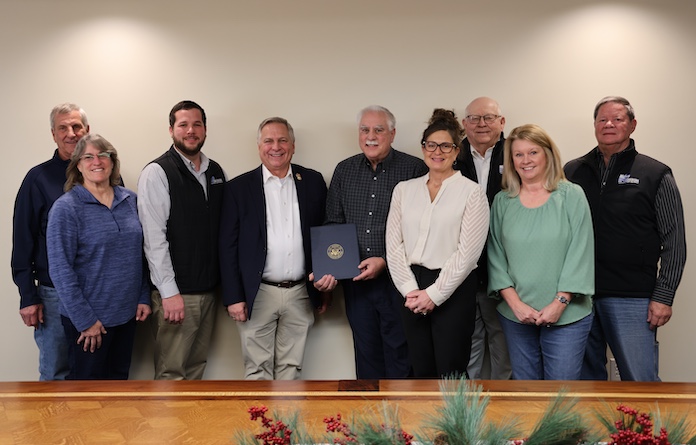
Ed Weilbacher was celebrated last Tuesday amid his final month as KRPD general manager, with U.S. Rep. Mike Bost (R-Murphysboro) dropping by for a surprise visit to the KRPD office in Red Bud to help recognize him.
Bost recited a declaration he had entered into Congressional Record recounting Weilbacher’s career and contributions to the district.
“Upon his recent retirement from the Kaskaskia Regional Port District, he had dedicated nearly 40 years of his life to conservation efforts and community engagement,” Bost said. “Ed has long been involved in Southern Illinois agriculture economy, acting as a driving force in several organizations including the USDA’s Natural Resource Conservation Service.”
Bost’s speech went on to further laud Weilbacher’s work, including his service sharing knowledge with Bost’s office, strengthening the KRPD and specifically helping to accrue over $46 million in project funding for the region.
Weilbacher himself spoke with the Republic-Times to discuss his tenure with the district and earlier career, recalling his roots as a graduate of Gibault Catholic High School.
Upon graduating, he attended Western Illinois University, earning a degree in agronomy with an emphasis in soil and water conservation.
He then made a space for himself in Northern Illinois for about 15 years, working with the U.S. Department of Agriculture’s Natural Resources Conservation Service.
Life then brought him back home, where he worked as the district conservationist for Randolph County, concluding his career with the USDA’s NRCS as coordinator for the area’s Resource Conservation and Development.
Looking back on his 36-year career with the USDA, Weilbacher recalled his time in Sparta as well as the expanded perspective he received in Mascoutah that helped prepare him for his time with the KRPD.
“I knew more about Randolph (County) as I was doing conservation work with farmers,” Weilbacher said. “When I went to Mascoutah, I was working on a regional level on natural resource projects that covered many counties. One of my first projects in Monroe County was working with the water quality issues of karst sinkholes that we have here… I was familiar with all the issues, sedimentation, streambed erosion, those kinds of things that are affecting the navigation channel.”
He remarked that his career experience there also helped him become familiar with many agencies in the region, with his connections helping him with some of what he undertook with the port district.
Weilbacher’s professional career came to a close 15 years ago, and he expected to enjoy retirement, though then-KRPD Chairman George Obernagel and Vice Chair Terry Liefer managed to bring him in to replace outgoing general manager George Andres.
It took some effort and patience to get him on board.
“When I retired in 2011, George and Terry… they approached me about the job of being the general manager,” Weilbacher said. “And I basically said ‘no.’ They were persistent. They tried two more times, and after the third time, jokingly, my wife said to me, ‘Why don’t you take the deal? You can always quit.’ So I agreed to take the job, and that was 14 years ago.”
Weilbacher further recalled how he was only planning on filling the role for a decade, though Obernagel managed to talk him into sticking around for a few years more.
Looking back on his service, Weilbacher noted it was a part-time position for those 14 years, three days each week. He remarked he wasn’t exactly looking for a full-time job, though the larger reason for this particular detail was that the district simply didn’t have the money or resources to necessitate or allow for a full-time general manager.
Weilbacher spoke about his start at the KRPD, becoming familiar with his district’s various contracts with its terminal operators.
He also had plenty to do when it came to working with the district’s board of directors – each of whom is appointed by the Illinois governor.
Not only did he have to get to know them, he also needed to discuss the state and various needs of the port district.
“After looking at infrastructure and some of the areas where we needed to replace something or build something or add something, I started coming up with a strategic list of capital improvements, so we developed a strategic plan, a long-range plan for the port and started implementing that,” Weilbacher said. “I was fortunate that the port itself was starting to grow with tonnage, and some of our companies that are in our terminals were starting to expand and create some jobs.”
Among Weilbacher’s biggest accomplishments as general manager was his work procuring an actual office for the KRPD, which was originally cramped and haphazardly arranged in a space at the Red Bud Post Office.
He received a lead on a building in town – an old grocery store-turned-antique mall – and looked into getting it remodeled, though the district had scant funds to throw around.
With that seed, a series of events transpired in which Weilbacher approached a tenant – Gateway FS – at one of the terminals who was looking to expand its footprint, working with them to set up an agronomy center.
Helping Gateway FS with its job creation, he was able to get a trio of grant funding sources from the Illinois Department of Transportation, Department of Commerce and Economic Opportunity and the Community Development Assistance Program to fund the extension of a water line and an entrance road for the KRPD No. 2 terminal.
He ultimately wound up with the funds to be able to purchase the current building located at 336 N. Main Street in Red Bud. Weilbacher offered his thanks to Quadrant Design as the architects for the space.
Another point of pride for Weilbacher is the staggering amount of grant funding he and his staff were able to acquire for the district.
“We were able to, over the last couple years, get grants approved totalling $45 million,” Weilbacher said. “We’ve implemented a little over $8 million so far. The next manager, then, is going to take what we have approved and implement those projects. That’s a very significant amount for a smaller port like us.”
Tonnage has also been a rather significant focus for him these past 14 years, and much progress has been made in this area as the district has pushed to recover from the loss of major coal tonnage years ago.
He remarked the amount of traffic the port district received was so low at one point that there were talks of ceasing operations at the lock and dam.
“That was the rallying cry that created the Lower Kaskaskia Stakeholders, the nonprofit group of people coming together wanting to champion the river,” Weilbacher said. “With their efforts and some of our business starting to think, ‘Hey, maybe I need to expand here a little bit,’ we started picking that tonnage up.
“When I got to the port, we were up to about 800,000 tons… Since I’ve been there, it went to 2.5 million… We are poised to go to about 4.25 million with some new tonnage coming onboard in the next year or two. We’re gonna be at a point where we’ll exceed the prior high numbers of tonnage, and we’re considered by the Corps of Engineers one of the bright spots within the river industry on increasing tonnage.”
Altogether, Weilbacher has overseen a period of tremendous and much-needed growth for the KRPD, with the district now in such a position that a full-time general manager is warranted.
“The demand for the job is greater than it was when I first got there,” Weilbacher said. “I was able to work with the board, and we made the position full-time. So the new person coming in is a full-time employee, and I’m proud of that.”
Both Liefer – who serves as current board chairman for the district – and Obernagel spoke about their experiences with Weilbacher, getting him into the district and working with him for over a decade.
Liefer recalled getting to know him as their paths crossed with the RC&D.
“I had worked with him some, not a lot, but I knew him, and I knew of his skills and qualifications,” Liefer said. “He was always a very thorough and organized individual. That’s kinda what got us trying to interest him into a job.”
He noted Weilbacher’s unique perspective given his tremendous experience in conservation and environmental issues, also commending him for his abilities when it came to getting grant funding.
On that, Liefer particularly recalled how, as the Fayetteville terminal was not within the KRPD, Weilbacher was still able to get a grant to get a road to the terminal, with a jet fuel pipeline to MidAmerica St. Louis Airport in the works.
That terminal was actually renamed the Weilbacher terminal in November to honor him for all his efforts over the years.
Liefer further praised Weilbacher for how well he worked with the board and his office, also remarking on how he led the district through tremendous success after his predecessor helped the district get back on its feet.
“He literally put the port district on the map. No disrespect for George Andres, our previous manager,” Liefer said. “George Andres helped keep the port district alive through some really tough deals, and then when Ed got on board, he was able to expand on that… We had no idea the lock was gonna stay open. They had considered closing it. Now it’s got the same responsibility as the major locks on the Mississippi River. It’s 24/7, and it’s gonna stay that way.”
Obernagel spoke with pride about how he and Liefer managed to get Weilbacher into the district.
“He’s done a wonderful job with the port district since he joined us,” Obernagel said. “He was only gonna work six or seven years, and I kept him going on ‘one more year, one more year, one more year,’ and his wife finally told him he had to retire.”
Like Liefer, Obernagel had plenty of thanks to offer for Weilbacher, saying it was simply great to work with him.
“He progressed the port district to new highs and tonnages,” Obernagel said. “He’s very creative when it comes to getting grants, funding new projects, doing roads, doing repairs to projects.”
Stepping in to replace Weilbacher at the start of 2026 is Brent Donovan, who has been working alongside him for some time to keep things running smooth during the change in leadership.
“Ed’s been instrumental in passing along the vast amount of knowledge with everything that he’s gained over the last 50 years of public service between the USDA and KRPD,” Donovan said. “It’s been a great transition… Ed has been instrumental as far as that transition goes.”
With a past career in private rail, Donovan voiced his eagerness in regards to carrying on the work Weilbacher has done.
“I think my background within rail operations is going to be instrumental in hopefully continuing the progress that Ed made over the last 14 years,” Donovan said. “There’s a lot of assets surrounding the rail infrastructure with the Kaskaskia Port District, so I’m looking to compound on that and continue the growth that we’ve experienced.”
As he finally enjoys a proper retirement this time around, Weilbacher is looking forward to enjoying a cruise to cap off his career, though he’s likely to continue sharing his knowledge and contributing to the region even after that.