Quilts of Valor for local vets
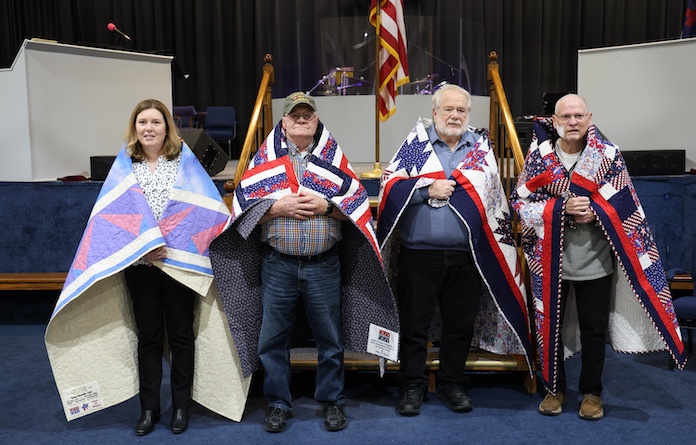
Early this month, a group of veterans were honored in Dupo by some local crafters who have taken to honoring servicemembers with the simple comfort of a quilt.
Stars of Honor is a local quilting group and just one of many chapters belonging to the nationwide Quilts of Valor Foundation.
The foundation began in 2003 as founder Catherine Roberts saw her son deployed to Iraq and had a dream in which the comfort of a quilt helped a veteran battle the trauma he was left with after serving.
In that same spirit, groups throughout the country have taken to honoring their area veterans with Quilts of Valor each year.
Stars of Honor held a ceremony Feb. 7, coinciding with National Sew Day, at First Pentecostal Church of Dupo.
Numerous quilters kept themselves busy through the afternoon, while everyone – including a number of families and other guests in attendance – offered their attention during the ceremony led by Dona Rector, who also oversees the Stars of Honor group.
“Today, I am extremely touched by all of the ladies that came out to support us and the families that came out to support our veterans,” Rector said. “I don’t know what to say. Thank you, and thank you for your service.”
Rector spoke about the origins of the foundation as well as the significance of each element of a Quilt of Valor before going on to recognize the four veterans chosen to be honored for this year’s ceremony.
Among them were William Brucker, Tammy Murawski, John Durrer Sr., and Ronald Habermehl.
Though Rector provided brief biographies of each veteran, Brucker and Habermehl offered some additional insight into their military careers.
With roots in Valmeyer as well, Habermehl said he’s lived in Columbia for most of his life. He said he worked for Luhr Bros. until his retirement in 2010, his family growing over the years with three children and seven grandchildren.
Habermehl began his service in 1968, enlisting in the Navy to work in construction. His basic training had him in Gulfport, Miss., before he moved to Camp Pendleton in California.
He spoke mainly about his service in Northern Vietnam – where he stayed for most of a year before being released in 1970 – transporting supplies for other troops.
“We just supported them,” Habermehl said. “Hauling different products, goods, bombs, ammunition, we did it all.”
He also spoke about his experience with Agent Orange, a highly toxic herbicide used during the Vietnam War, as he was exposed to the compound while transporting it – though he didn’t know much about it at the time.
Encountering health problems over the past few years, he spoke about how he wound up at the Mayo Clinic in 2022, suffering from Parkinson’s disease and general stability issues.
He spoke about the extensive testing required to confirm Agent Orange as the cause, though he still deals with the herbicide’s impact.
Brucker also noted his Columbia origins. He worked for a time after high school before attending junior college for a time, ultimately getting caught up in the draft – though he wound up signing on for a battalion with the U.S. Navy Seabees, special units focusing on building or repairing infrastructure.
Briefly recounting his service, Brucker noted he was deployed for nine months before being brought back to the states for six months. He also spent time in Puerto Rico on peacetime deployment.
From Puerto Rico, his particular detachment was sent to Panama to construct a golf course, pave the streets of a naval base and more.
Speaking on the recognition offered by the Quilts of Valor ceremony, both Brucker and Habermehl were extremely appreciative, noting the impact of the honor given their backgrounds as Vietnam-era veterans.
“It was just very emotional,” Brucker said. “I just couldn’t believe that somebody would do that for us. It brought back a lot of memories from that time, and I was very humbled by it… When you’re from the Vietnam era, you weren’t very well looked upon when you got back, so it was nice to finally really be honored and rewarded.”
Habermehl was likewise exceptionally thankful.
“It was overwhelming, what they did,” Habermehl said. “I still really don’t know the process of how they work, but it’s real nice… It’s good to know you’ve got people behind you.”