Fix found for Fults levee
Residents of the Bottoms in southern Monroe County and Prairie du Rocher can “breathe easier” with repair work now underway on a scour hole near Fults, Monroe County Public Safety Director Kevin Scheibe reported during last Wednesday’s meeting of the Monroe County Board.
Scheibe explained that a plan to fill the scour hole was approved by the U.S. Army Corps of Engineers on Oct. 31.
With help never materializing, a retired civil engineer with extensive knowledge of the river system near Fults was brought on board to provide a fresh perspective to the problem last month.
His suggestion was a novel idea for fixing the problem in the Stringtown Drainage and Levee District that involved taking the original levee nearby and using those materials as fill.
The “legacy levee,” built by private farming interests in the 1800s, was later replaced by an extensive levee system on the banks of Mississippi River in the 1940s.
The Corps did not remove the old levee during construction of its levee.
Scheibe commented that the “old farmers knew what they were doing” while constructing the original levee, saying it is in better shape than some sections of the current levees.
Stringtown Drainage and Levee District Chairman Lynden Prange explained the levee became part of the solution but is also the problem.
Prange told commissioners the Corps earlier this year “finally admitted that the old legacy levee was the culprit” in the formation of the scour hole, adding there are likely small scour holes or the beginning of similar situations throughout the levee systems south of St. Louis.
He continued by noting the structural integrity of the old levee is what led to the problem in his district.
Prange explained that river velocity increases south of St. Louis due to development upstream, “commercialization” of the river and “constant dredging.”
The flow becomes more restricted in the area between the levees while also gaining more speed before getting trapped as the legacy levee gets closer to the current levee to the south.
The result is rapid-moving water with a narrow outlet which produces a swirling vortex that has been continuously eroding the base of the current levee and producing the scour hole, Prange continued.
Scheibe said the scour hole displaced about 50,000 cubic feet of sand. It was determined the sand, coupled with approximately 35,000 cubic feet of clay from the legacy levee, would be enough to essentially repair the damaged levee foundation.
The Corps approved the plan, adding a stipulation that only materials expelled from the scour hole and organic material from the “footprint” of the old levee may be used for repairs.
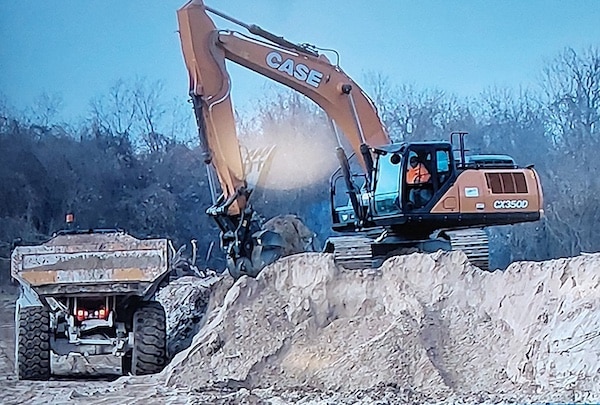
Scheibe reported work began on Nov. 10, with just under 100 loads of material moved per day at an average of 33 cubic yards per load.
He added the repairs could be complete within 30 days.
The fix is timely and cost-effective, as there is no material cost, and transportation costs are also significantly diminished.
Scheibe initially estimated a base cost of $3.5 million to repair the levee, not including the cost to repair county roads which would be necessary due to the estimated 3,500 semi-truck loads which would have been needed to bring fill and repair materials.
County officials were also able to secure daily equipment and labor rental from Luhr Crosby Marine Contractors in Columbia.
The maximum cost of the repair is now $400,000, and the final amount may be half of that.
Repair estimates when the problem was first announced publicly in August ranged from $3-6 million.
The scour hole was discovered in 2010, but an alarming increase in its size and rate of growth discovered earlier this year prompted Scheibe and other interested parties to engage a number of organizations and elected officials in an effort to address the situation before the hole grew to a point at which it could cause a complete levee failure.
During Scheibe’s initial report to the Monroe County Board in early August, he predicted “devastation” within 18 months for up to 45,000 acres of land and 500 residences in Monroe County in addition to the Fort de Chartres State Historic Site and surrounding area in Randolph County should nothing be done to repair the scour hole.
With the cost out of the range of local governments and organizations, Scheibe realized it would take state and federal funds to finance the previous reconstruction plan.
At the time, it did not seem as if help would be available in time to avoid flooding in the Bottoms.
The Corps was unable to step in since it is a “reactive” agency and restricted from intervening with a levee prior to an actual failure.
Turning to local lawmakers also proved unsuccessful.
Although U.S. Rep. Mike Bost (R-Murphysboro) managed to get a grant from the Illinois Emergency Management Agency to its federal counterpart, that effort was for naught since FEMA’s Building Resilient Infrastructure and Communities program had been frozen since April, meaning the $750 million earmarked for natural disaster mitigation efforts was unavailable.
State Rep. David Friess (R-Red Bud) has also introduced legislation aimed at overhauling the entire Stringtown District levee system, although its potential passage would probably not have been in time to prevent the failure within 18 months Scheibe predicted in August.
Fortunately, the levee is “a little more secure” since the repair project began, but there is still need for broader improvements, Scheibe said.
The first step in repairing the scour hole was to remove trees and other growth from the levee, Scheibe said last Wednesday.
In doing so, “two more scour holes were discovered after the vegetation was cleared,” Scheibe continued, adding there are likely small scour holes or the beginning of similar issues along the Illinois levee system from St. Louis to Memphis.
Josh Rodenberg, a Randolph County resident who submitted an op-ed to the Republic-Times, argues that the current operation should be only the beginning of a major overhaul of the Bottoms levee system.
He argues that once the scour hole is fixed, the next steps should include rock armoring, concrete revetment, redesigning the levee’s cross-section and reinforcement of the levee’s “toe.”
Read Rodenberg’s full op-ed by clicking here.
While no funding for the current work has been finalized, Monroe County Board Chairman George Green said the costs will be shared among several stakeholders in the levee.
He also noted local elected officials at all levels are continuing to apply for grant funding and other non-local revenue options to finance levee projects after the current repairs are complete in addition to promoting levee legislation.