Solar disarray in Columbia
With an overhaul of Columbia’s municipal code in the works, it became apparent Monday night that regulations concerning solar power installations need to be clarified.
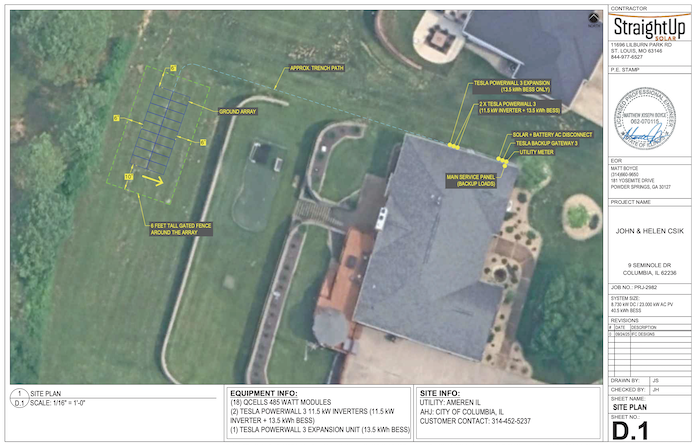
Aldermen considered a discussion-only agenda item of a special use permit to install ground-mounted solar panels at residential property during Monday’s council meeting.
The request failed to gain approval during a Columbia Plan Commission meeting Dec. 8 with four members voting to recommend denial, one against and one abstention.
Monday night, Columbia Land Use and Planning Coordinator John Brancaglione introduced the topic, explaining the plan commission’s main reason for recommending denial of the permit was “there was no legitimate reason that roof mounting was not possible” and “the petitioner had not supplied significant evidence” to support opting for a ground-mounted array.
Ward IV Alderman Steve Holtkamp began the discussion by disagreeing with the plan commission’s interpretation of Columbia’s solar ordinance.
The commission’s vote was based on an opinion which only allows ground-mounted arrays in an instance roof-mounted panels are not an option.
“I don’t think that’s the case,” Holtkamp said, adding he interpreted the ordinance as making the ground-mounted option equally as viable, with the special use permit required as a way to ensure proper placement of solar panels on a particular property.
Brancalione noted “several concerns” about ground-mounted solar panels, most notably a placement of panels which would affect adjoining residences, particularly in subdivisions – although he said Columbia’s ordinance did not contain language preferring roof-mounted panels.
In September, aldermen unanimously denied a request to install a ground-mounted array at Christ Community Church off Gall Road, mostly because neighboring property owners did not like the idea.
That is not the case for the subject property discussed Monday night.
This property is located on top of the bluffs, with the nearest property visible from the backyard being the Sunset Overlook bar and restaurant to the west, which is several hundred feet below where the panels would be placed.
“It doesn’t make sense to me,” Holtkamp continued, referring to the plan commission’s rationale. “Basically, what we’re saying is there’s no way you can put a ground-mount in. If this one wouldn’t do it, as far away as it is and in the middle of nowhere, in the backyard… I think (the ordinance) was misinterpreted.”
Brancaglione concurred with Holtkamp’s assertion, adding city code does allow for ground-mounted solar panels without need to explore rooftop installation.
Mayor Bob Hill asked if the proposed panels have anti-reflective qualities, saying he found many municipalities require that as part of their codes.
Brancaglione and a representative of StraightUp Solar, the business which would be installing the array, both confirmed the panels are anti-reflective.
The StraightUp Solar representative also noted ground-mounted panels absorb light reflected from below, making the setup more efficient.
The property owner and a neighbor also addressed the council, with both noting the wind on top of the bluffs already creates problems with house roofs, making ground installation the best option.
The neighbor also said the proposed ground-mounted panels would be barely visible from his property, which has the only vantage that could be affected by the installation.
Hill also asked about “abatement” of solar panels once they are no longer useful, which Brancaglione explained is already required as part of city code.
Ward II Alderman Lauren Nobbe also agreed with Holtkamp’s interpretation of the ordinance, suggesting changes need to be made.
“The ordinance needs to be a lot clearer with that interpretation,” Nobbe said. “This is Pandora’s box for sure… It’s going to get ugly real quick.”
Ward II Alderman Michael Lawlor offered similar sentiments, with Columbia City Administrator Doug Brimm noting city staff will need direction from the council on the matter during the full municipal code update.
The special use permit is expected to be voted upon during a January council meeting.
Prior to that discussion, Brimm pointed out that a proposed second amendment to the city’s purchase agreement for a property at 11800 Bluff Road had been tabled during the Dec. 1 meeting, adding the item would “die” if it were not reconsidered during Monday’s meeting.
Brimm explained the seller did not wish to “move forward in that direction,” although details of the second amendment were not disclosed during either meeting.
With no motion to reconsider, the agreement reverted to the first amended version, which included about $65,000 in credits to the city for various repairs and transfer of a roof warranty on the current building.
Brimm also noted the purchase is set to close in early February despite second amendments being rejected, and the city is still exploring options for a “bridge loan” to finance the project.
The project will relocate the city’s government operations as well as its police and EMS departments.
The city approved a purchase of the property and existing building for $6.9 million.
The new police and EMS headquarters are expected to add about $8.5 million to the total project cost.
Last month, the city approved an architectural and engineering proposal with Quadrant Design for development of the new emergency services facilities not to exceed $628,575.
During discussion of a home-rule referendum in 2023, a new public safety complex for emergency services including the Columbia Fire Department was estimated to be in the $15-20 million range.
The CFD will not be relocating to this new municipal complex near 11 South.
In other discussion, aldermen reviewed the preliminary plat for a second phase of the Walnut Ridge Subdivision off Rueck Road opposite the Briar Lakes Subdivision.
Lawlor lauded the developer’s inclusion of clear drainage plans on the plat, also asking if there are mechanisms in place for future property owners to not make changes to a parcel which would affect stormwater runoff.
Last month, several residents spoke during a council meeting regarding the city’s response to damage caused by inadequate runoff considerations.
Brancaglione explained the Walnut Ridge Homeowners Association is responsible for managing any “improvements,” which would, in theory, prevent structural changes that would affect drainage plans.
Brancaglione also noted that current work at a Columbia park is being done with respect to a new Environmental Protection Agency initiative which, if approved, would require all construction to have a minimum setback of 50 feet from any federally-recognized streams.
The proposed change comes as the EPA announced last month it may reduce the number of waterways covered by the Clean Water Act.
The next meeting of the Columbia City Council will begin at 6:30 p.m. Jan. 5 at City Hall.
Livestreamed and recorded meetings are available through the City of Columbia, IL – Government Facebook page.