MCSD goes high-tech
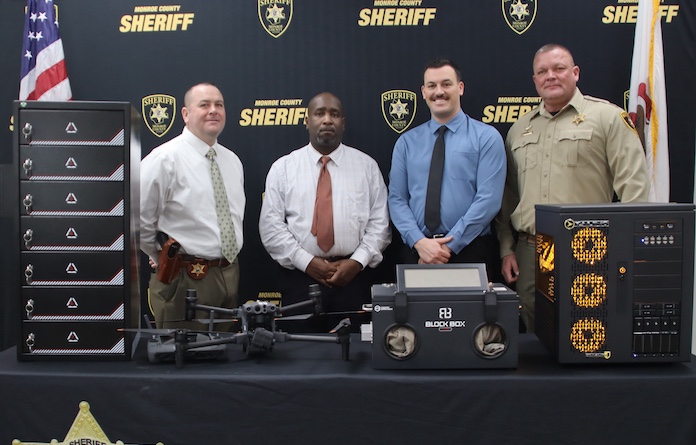
As technological advances continue to grow by leaps and bounds, law enforcement agencies have been forced to find ways to handle an increasingly rapid influx of digital evidence.
With new digital forensics gear acquired by the Monroe County Sheriff’s Department, it has quickly become the envy of metro east law enforcement – including much larger departments.
With several Monroe County Circuit Court cases this month alone relying on digitally-acquired evidence taken from cell phones, the need for timely processing and secure storage of such data is apparent.
In a press release issued Thursday, Sheriff Neal Rohlfing said his department has “implemented multiple upgrades within the investigations division” which include advanced cell phone forensic analysis, secure evidence storage for digital devices and significantly enhanced data processing capabilities.
The new equipment was purchased using funds from Monroe County’s share of federal asset forfeiture revenue and grants.
The Republic-Times was invited to MCSD headquarters in Waterloo last week for an introduction to this new equipment.
MCSD Capt. Justin Biggs and investigators Calvin Savage and Wes Degener joined Rohlfing in describing the application of these devices.
Biggs said the department now has “top of the line” digital investigation gear, with three of the new devices used in enhancing the department’s ability to access, analyze and store data from cell phones.
The first gadget discussed was the Blocker Locker 7 a “charge-and shield” evidence cabinet with seven individual storage compartments each equipped with internal charging devices.
“This system resolves a long-standing challenge associated with storing seized cellular devices,” Rohlfing said, explaining that each compartment acts as its own “Faraday bag.”
A Faraday bag prevents any external wireless signal from reaching a device stored within. For the MCSD, that means cell phones confiscated as evidence will not be susceptible to tampering from a remote location.
While the Blocker Locker is used for storage, the department has also recently added a “BlockBox” device which allows investigators to safely access and analyze devices without exposing them to wireless signals.
The BlockBox allows officers to physically handle devices using built-in gloves and view screens through a shielded window during data extraction, creating a controlled, isolated environment for sensitive investigations.
While the Blocker Locker and BlockBox are vital to secure digital storage, the real workhorses in digital investigations are a new high-performance digital forensic processor and a software system that have already proven useful since being implemented late last year.
Without shedding too much light on the investigation process, Biggs referred to the exponential increase of cellular device storage, much of which can be used to aid investigations.
He explained it is “nothing to have a 300 gigabyte phone” in terms of storage capability.
For comparison, 128 GB of storage was only available in high-end PC packages circa 2010, prior to the implementation of more current, higher capacity digital storage technology.
Biggs continued by noting the extraction process used to take days, if not a week or longer, but now requires only a matter of hours for device processing
The new MCSD workstation provides “exceptional RAM capacity…allowing investigators to efficiently process large volumes of data.”
Although such data has already been used by the MCSD recently to assist St. Clair County law enforcement in two murder investigations, analyzing that amount of information can be a daunting task.
Fortunately, the increased speed of extraction is complemented by a state-of-the-art software system that efficiently provides invaluable analysis of the data.
Degener shared that one of the software system’s capabilities allows it to arrange specific data points and associate them with probable behavior patterns.
Degener said a colleague shared the advice that, with the current capabilities of mobile devices, cell phones should “only be used to order pizza.”
The MCSD is the first St. Louis metro area agency to use the software, which has been utilized in helping solve at least five cases in the two months since being activated.
The new gear not only allows investigators to more quickly access and analyze information, but the cloud-based software system allows for streamlined collaboration with the prosecuting arm of local judicial systems.
The online sharing of evidence not only saves time by eliminating the need to transfer data to a physical device and then deliver the device to the appropriate parties, but the system also allows for multiple users to access information simultaneously.
The system, along with the new device storage systems, allow for easier accomplishment of chain-of-custody protocols.
While the focus of many investigations is to connect suspects to alleged criminal activity, Biggs shared that the technology has also been used to clear people suspected of wrongdoing.
The technological capability in Waterloo has led to inquiries from several outside agencies, with the St. Louis Major Case Squad proposing the MCSD system be utilized as part of its investigations division.
With recent upgrades to the MCSD facilities, it has become a hub of law enforcement collaboration in the past few years, and the new high-tech equipment is solidifying Monroe County as a leader in contemporary digital investigation practices.
The resources in Waterloo have already been used by Savage in his work with the Metro East Auto Theft Task Force and other deputies and officers working with the Metropolitan Enforcement Group of Southern Illinois, interdiction and drug trafficking units and the Internet Crimes Against Children Task Force, among others.
“This regional collaboration reinforces the department’s reputation as a reliable and professional investigative partner and underscores the value of investing in modern forensic technologies that benefit both local residents and surrounding communities,” Rohlfing said.
While not as cutting-edge as the digital forensics equipment, Rohlfing also noted another equally impactful addition to the MCSD, that being a drone available for search and rescue efforts.
“This is huge for us,” Rohlfing said, adding it has infrared and night vision capabilities and may be used in a number of scenarios, including search-and-rescue events, narcotics investigations and high-risk situations, including those which involve barricaded individuals.
The drone has a civilian use also, as it is used by the Monroe County Clerk’s Office for mapping and platting purposes.
“We’re leading at the tip of the spear,” Rohlfing concluded, although he also acknowledged the shortened practical use of such technology.
He admitted it is only a matter of time until the coveted MCSD technology is outdated or obsolete, requiring his department to remain vigilant in exploring emerging technologies in an effort to provide the best service possible to county residents and remain a leader in regional law enforcement.