Columbia clears the air
There has been something in the Columbia air lately – but it’s not romance or the sweet smell of early spring flowers.
With multiple Columbia residents reporting a foul odor originating from the city’s wastewater treatment plant west of town, aldermen approved a measure Monday night that should clear the air sooner than later.
A proposal to remove approximately 4.5 million gallons of “sludge accumulation” from a cell at the city’s wastewater treatment plant was accepted during the Columbia City Council meeting.
Metro-Ag Inc. will perform a “mechanical removal” of the stinky sludge and transport the material to an off-site location, with the project expected to cost approximately $382,500 – about 8.5 cents per gallon.
City Administrator Doug Brimm explained the city’s use of “biological treatments” to remove sludge accumulations is now being outpaced by the amount of effluent the plant receives.
“It’s a good problem to have. Columbia’s growing. There’s new homes being built on a regular basis; new businesses that are contributing to the plant,” Brimm said.
The mechanical removal of the excess material will also serve to increase the circulation of oxygen in the primary lagoon cell, thereby improving the effectiveness of the biological treatment.
The project will also “mitigate odors that are experienced whenever we have the extreme temperature shifts,” Brimm said, explaining that wide temperature swings in a short period of time brings the waste materials to the top of the cell, creating the city-wide odor when winds are out of the west.
The decision to use Metro-Ag was based on its ability to dispose of the material off-site.
The city received a separate proposal that would have applied the removed sludge to land adjacent to the plant – a technique that would “severely exacerbate the very issue (the city is) attempting to resolve,” Brimm wrote in an agenda report.
The decision was made to address a current problem while also keeping in mind “significant improvements to that plant” required by the Illinois Environmental Protection Agency by 2035.
Alderman Steve Holtkamp asked if the removal would have been required whenever the plant upgrades begin.
Brimm confirmed the thought, adding the city has been “cognizant” of the needed upgrades, with the city focusing on “initiatives that can be carried over into the new configuration.”
Although there is not yet a timeline for the project, Brimm said the city has been in touch with Curry and Associates to prepare the land permit needed by Metro-Ag to deposit the removed material, adding that “should be a pretty quick process.”
Mayor Bob Hill applauded the effort, saying it is “very much needed,” adding he is “sick of smelling the sewer plant, and I think everyone else is, too.”
It was also noted the removal process will likely generate an odor, and the city plans to communicate with residents to manage expectations prior to this project beginning.
Municipal services such as utilities and transportation are at the core of local government functions, and for a growing city like Columbia, the work is never done.
While Valmeyer Road reopened last week following nearly a year-long closure, and the Bluff Road bridge project is also complete, the city is now focused on another roundabout construction project slated for 2027.
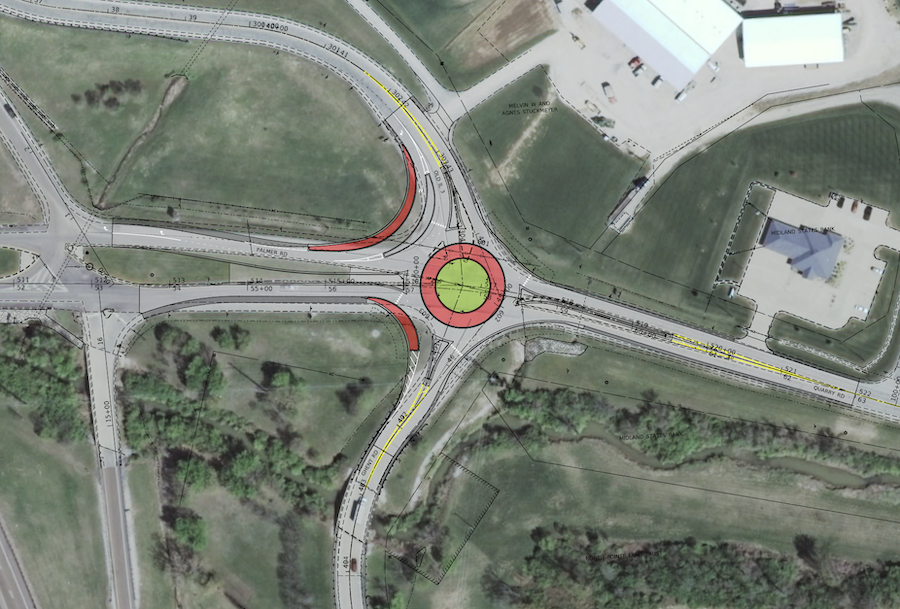
On Monday, City Engineer Chris Smith reported on a public informational meeting held Thursday regarding the roundabout project which will incorporate the intersection of Old Route 3 and Ghent Road Palmer and Quarry Roads near I-255.
Smith said about 60-70 people attended the March 12 meeting, with the connectivity of Old Route 3 with Palmer Road the most frequent question asked.
As the project will have the greatest effect for residents in the area of the Columbia Lakes subdivision, Smith said he was able to assuage any concerns about construction traffic.
Speaking during the Feb. 17 meeting, Smith explained the staging of the project, noting first of all that temporary access from Columbia Lakes to Palmer would be designed to maintain two-way traffic during the project.
Without that consideration, Smith said motorists may have been required to access I-255 to return to Columbia.
The staging of the project is designed mainly to “keep the flow from Columbia Lakes to Quarry (Road)” unimpeded, Smith said.
He also proposed closing Ghent and Quarry roads for a short period during the first phase of the project as a way to ensure safety and simplify construction while also maintaining traffic flow.
He estimated the project will take 10-12 weeks. With bids on the project expected to be let in the fall, Smith said the roundabout construction can be mostly accomplished while nearby Immaculate Conception School is not in session.
An additional challenge for this project is the need to change the “vertical profile” of parts of the connecting streets which will cause “lane drop-offs” during construction.
Smith also noted the abnormally large size of this future roundabout.
The roundabout’s footprint is due to Illinois Department of Transportation requirements, adding another layer of complexity to the project.
A more definite timeline should be known following the bidding process this fall.
As previously reported, Valmeyer Road opened last week after an 11-month closure.
Smith said the final work of oiling the road surface could be completed by the end of this week, also noting a potential for delays as March is not the “season for oil.”
A Monroe County project along Bluff Road just north of Valmeyer Road also wrapped up last week, freeing up traffic to resume in that section of the city.
The next meeting of the Columbia City Council is scheduled to begin at 6:30 p.m. April 6 at City Hall.
Council meetings are live-streamed and available for later viewing at the city’s Facebook page, “City of Columbia, IL – Government.”