
Keeping Columbia’s history
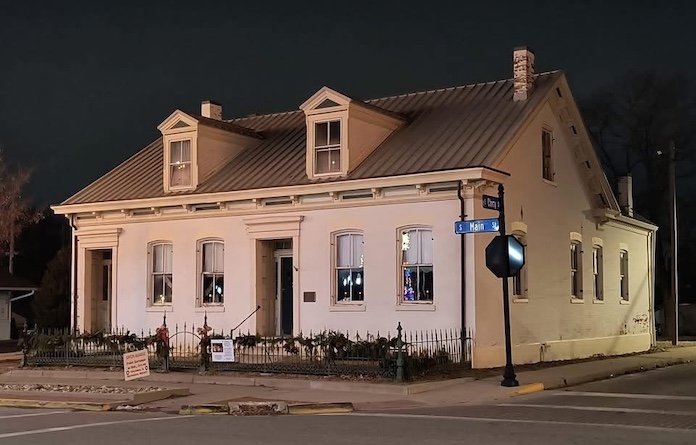
An historic house along Main Street in Columbia received some much needed love and care last year after nearly a decade of vacancy, opening its doors for the holiday season just before being recognized as another important stop along the Kaskaskia-Cahokia Trail.
Local historian Dennis Patton spoke on the history of the Miller-Fiege Home, particularly discussing its more recent history as its preservation became a concern for the City of Columbia and a major project for the Columbia Historical Society.
Patton noted that the house across from City Hall on Main Street was last occupied in 2008 by Winnefred Fiege, who was interested in seeing that the building was preserved.
City leadership at the time was likewise interested in seeing the house was maintained – Patton recalled longtime alderman Mary Ellen Niemietz being a strong proponent of the preservation – as so many historic buildings had been destroyed in the past.
“The city thought that they had lost so many of the old, stately original homes in town that they needed to try to save this one,” Patton said.
Ultimately, the Columbia Historical Society got involved, making great strides to see that the home was kept in decent condition inside and out with some help from the city and community.
Patton pointed to former Columbia Director of Community and Economic Development Paul Ellis for his efforts in working with the historical society on the preservation effort.
“They went in and tried to make sure that the inside of the house was kept in the same state it was,” Patton said. “A lot of the wallpaper and things were original, and they were starting to come loose in the house. With his guidance, the city put in a new heating and cooling system which was very important.”
Also among the work that was done, Patton noted how Charles Todd made a substantial donation toward a new metal roof for the building.
Patton further recalled the amount of activity the Miller-Fiege Home saw from 2014-2016, with many open houses and participation in a number of festivals and other events in the city.
Eventually, however, many members of the historical society who were quite active with the home became too old to continue or were otherwise unable to keep up the work that went into maintenance, and so the home stood quiet for several years.
Looking back well before the 21st century, the house has plenty of history as detailed in a presentation put together by Patton.
It was constructed in 1850 by Johannes Dahmer, who emigrated from Bremen, Germany – close to Columbia’s sister city of Gedern – in 1842.
It was purchased in 1857 by Peter W. Miller, whose granddaughter Elizabeth married a man named Ferdinand Fiege, thus earning the home its name.
The final residents of the home were the aforementioned Winnefred and her sister Dolores Fiege, third-generation descendants of Miller.
A German cottage with Italianate influences, the home is a brick house one-and-a-half stories tall with a limestone foundation. It features segmental-arched brick lintels over the original windows and secondary doors and long green shutters typical for Germans who settled in the Midwest.
Among the other key architectural features of the house is the kitchen which was added years after the original construction. Patton remarked this addition has seen a number of issues lately, including leaks.
The interior of the home also features various pieces of furniture from throughout the house’s history, including a Victrola.
After several years of quiet, in the spring of last year the historical society found itself renewed membership and vigor, boasting around 40 members keenly interested in maintaining a trio of historic buildings in the city.
“In April and May of 2025, we re-organized the Columbia Historical Society,” Patton said. “Our goal was to help preserve and to make available for the public the Miller-Fiege Home, Sandbank School and Shoemaker School, the three historic buildings that we have in Columbia that the public is allowed to use.”
While the schools have undergone their own maintenance and restoration in recent memory, Patton further discussed work done on the Miller-Fiege Home in the past few months.
Along with all the cleaning required inside, he recalled an architectural study that was conducted and showed the house’s double brick walls and fairly good state of repair, with only a few places requiring tuckpointing and only a little repair required of the windows.
Though some parts of the house require some additional attention, the space was in a good enough state to open to the public several times in December.
“It wasn’t as bad as we thought it was gonna be,” Patton said. “We were figuring early on it was gonna cost us $75,000 to do the work in the house just to get it where we could use it, and once the engineering study came through, the city agreed to allow us to go ahead and clean it and open it at Christmas time this year which was the first time it’s been open since basically Christmas of 2016.”
Alongside Patton, Lillian Koenigstein with the historical society spoke about the group and their efforts in the community.
She noted the impact that the COVID-19 pandemic had on the society’s activity, adding that the brunt of their focus nowadays is on the Miller-Fiege Home.
Commending Patton for his unofficial leadership, Koenigstein pointed to Diane Hanna as the group’s secretary, Max Kutterer-Sanches as resident architect and herself as treasurer.
She said the society’s main goal at the moment is to continue having the home available for tours. With some in December, another event is planned for this spring though no date has been set at the moment.
Koenigstein also mentioned plans to open the space up during the city’s July 4 celebration and Columbia Days event.
She spoke to the organization’s goal of preserving and sharing Columbia’s history.
Patton echoed this sentiment, speaking chiefly about the Miller-Fiege Home.
“The goal is for the house to be a historic house museum so people can actually visit it and see what it was like in the early days of Monroe County,” Patton said.
For those interested in joining the Columbia Historical Society and contributing to the preservation efforts, the group’s next membership meeting will take place Feb. 24 at Turner Hall starting at 6:30 p.m.