Teen drug trend talk
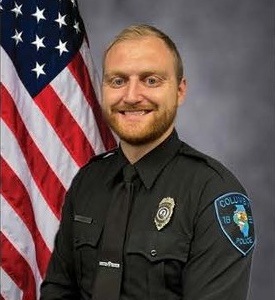
The Monroe County Coalition for Drug-Free Communities began the new year with something of a deep-dive into youth drug trends courtesy of Columbia School Resource Officer Tyler McWhorter.
Most of the Jan. 7 meeting centered around McWhorter’s presentation, which focused on research he’s conducted in the community and testimony he’s heard from various students as well as store owners and employees.
McWhorter opened his presentation with a personal introduction, noting he’s been in Columbia for five years.
His work as SRO for the Columbia School District sees him working closely with students on a regular basis, further supplemented by his role in Columbia High School’s Operation Snowball group, an effort on the part of the coalition to help local students build leadership skills and address youth substance abuse in their community.
McWhorter explained that, as a Columbia resident, his work in the area of substance abuse prevention is very much personal.
“I do have skin in the game,” McWhorter said. “My kids are going to grow up here in Columbia. I want to have them go to school in a community where they feel safe and not pressured to try these drugs and substances. It’s on all of us… It’s up to us, the parents and the community leaders to start addressing the issues we can control.”
He went on to discuss the work being done among the students involved in Columbia’s Operation Snowball group.
In particular, students have placed emphasis on building a space for them and their peers to socialize and spend time in a safe environment outside typical clubs or cliques. McWhorter remarked that the club is looking to provide a space for those students who might not spend much of their time among teammates or friends from church.
“This has kind of been the kids also jumping onto these things that they find important,” McWhorter said. “They have identified that there’s not a lot of spaces for them, outside of the clubs and sports that’s already there, for them to fit in… There’s not really a space in the middle for everyone to kinda collaborate. They’ve taken off with this program, and they’ve taken all the ideas and principles of just being student leaders, being drug-free, and they’ve taken that to all these people in the middle school, so they’re starting to impact tons and tons of other people just by the effort that they put in.”
The bulk of McWhorter’s presentation focused on providing an overview of certain substances that seem to have boomed in their popularity among youth in the region.
Asking those present at the meeting what attracts youth to certain substances, many responses brought up popularity or peer pressure.
McWhorter instead noted ease of access and affordability.
He explained that a lot of young people find their substance of choice at pharmacies or gas stations.
Many products, he said, don’t have age restrictions – or wind up being sold to minors even if they shouldn’t be – and current law allows various THC derivatives to be sold outside of dispensaries, making them exceptionally widespread – though legislation passed last year is set to go into effect later this year to help address this particular derivative issue.
McWhorter went on to point to a number of products that have been growing in popularity recently, with alcohol, vapes, nicotine and the aforementioned THC derivatives among them.
THC products are among those that have boomed given the numerous variants and ubiquity, often being sold very cheap at the counter.
He mentioned the brand Geek Bar specifically, also noting these products can come in many shapes such as vapes, THC-infused drinks or candy.
McWhorter also spoke about kratom, perhaps the most popular substance behind THC.
He noted that products containing it are illegal for those younger than 18, and a low dose might act as a stimulant or “upper” while a larger dose often acts as a depressant similar to an opioid.
He further spoke about how much space these products take up in shop displays.
Additionally, he remarked that 7-hydroxymitragynine, a derivative of the kratom plant, is often referred to as “gas station heroin.”
Recalling some conversations he’s had in his work, McWhorter spoke about one individual who suffered from an opioid addiction and used this particular substance to wean off of harder opioids.
Kava was another drug which received McWhorter’s attention. Another plant, he described it as a “potentiator,” able to substantially increase the effect of other substances – he noted it’s strongly advised to not consume with alcohol.
This, he said, can often appear as the Feel Free drink brand, which is marketed as an “alcohol free” beverage.
McWhorter also spoke about mushrooms, specifically amanita muscaria. While psilocybin – known as magic mushrooms – is an illegal substance, amanita has come to be sold as an alternative with no age restrictions.
Often appearing in chocolate bars with various proprietary blends, he said an analysis of these bars in California revealed that many of them actually contain psilocybin.
Prescription drugs are also still popular, per McWhorter, with adderall still being a sought after stimulant though he hasn’t seen it much locally lately as it seems to have become more difficult to obtain.
Proprietary Addall being sold in stores has come to be an alternative, and gabapentin – an anti-seizure medicine which rose in popularity around 2018 – seems to be making a comeback.
Regarding other trends, McWhorter also spoke about how vapes have come to be stronger than they were in the past, with many products offering vastly more puffs than older models.
He also discussed how students tend to hide their vapes, with brands like Sprayground or Cookies offering things like backpacks that are either smell-proof or feature a hidden compartment. He also mentioned certain hats having their own “stash pouch.”
In a similar vein, McWhorter spoke about the Penjamins brand and various THC vape products that are disguised as pens, car keys, lip balm, markers or toys.
He concluded his presentation by urging parents and those present to do more to educate themselves about what their kids might be doing.
“You can’t prevent what you don’t understand,” McWhorter said. “Do some research into a lot of these products. If you are using anything in here, it doesn’t mean that you’re addicted or have a substance problem, but what these kids are finding out through TikTok, through social media is, ‘I can use these legal products to get high. I can use them to get drunk,’ and that’s what they’re using them for. They’re not using them as intended.”
Addressing a handful of questions from the audience, McWhorter spoke about alcohol consumption among youth, noting fake IDs seem to be growing in popularity again – seemingly as young people don’t realize possession is a felony offense – though procuring alcohol from parents or older siblings is still common.
He also touched on what the coalition or others might do, pointing to the difference he’s seen himself simply by speaking with shop owners or clerks about trends and product placement near the counter.
“I think a lot of it can be done through conversations with the owners through the clerks,” McWhorter said. “At the end of the day, it’s a free market. They’re gonna sell what they wanna sell. But we could potentially get these warnings out there, get the age limits posted so it’s very clear, ‘This is who this is for.’”
In other coalition news, Executive Director Monica Kirkpatrick spoke about the recent successful Snowball fundraiser as well as the continued efforts to build and grow Operation Snowball groups outside Columbia.