Woolly work for BaaBaa Girls
It’s no secret Monroe County youth shine when it comes to agriculture, and two Waterloo freshmen are set to uphold that reputation as they’ve been hard at work bringing an innovative use for wool to the region.
Gracie Stechmesser and Kaleigh Halleran have long been active in 4-H and have likewise been busy in FFA, each raising their own sheep for years.
With plenty of assistance from their mothers Leanna Stechmesser and Amy Halleran, the pair are hoping to soon officially start BaaBaa Girls Wool Pelletizing, a business making use of the ubiquitous and unusable wool in the area.
Leanna offered a background and overview of the business and the girls’ efforts, noting how their families have been close for many years.
When it comes to wool, she explained that sheep in Monroe County and much of the region are raised for their meat more than anything, their coarse wool proving unusable for textiles.
Leanna recalled how sheep producers in the area long made use of a co-op out of Ohio which would purchase local wool from all over the region, though they had to close as the COVID-19 pandemic began.
“Markets really went down and the co-op, Midwest Wool Growers, they closed their doors,” Leanna said. “So basically everybody east of the Mississippi River has not had any outlet to go with all of their wool. So we have barns and sheds in the area that are just piling up with wool, and nobody knows what to do with it.”
In this environment, the Hallerans and Stechmessers found themselves at a meeting of the Monroe County Sheep Producers where this matter came up in conversation.
As something of a joke, Amy and Leanna suggested Kaleigh and Gracie get on their computers and try to find a solution.
With a bit of research, they did.
Wool pelletizing, as Leanna explained, is the process of shredding wool to remove any waste and then compressing it, resulting in pellets that serve a variety of purposes when used in gardening.
“People have purchased some equipment, some machinery, and they are taking the coarse wool that nobody is using any longer, and they are converting it into a pellet that is used basically as a soil amendment for gardens and potted plants and those kinds of things,” Leanna said.
“Wool naturally imbibes and holds water,” she continued, “so as you incorporate these pellets into the pots or into the soil in gardens, the wool will fill with water, and then as the soil dries, it’s a slow release of moisture into the roots of the plants, so it’s a great thing for water conservation. It also has a natural fertilizer content to it. It has a higher nitrogen content to it.”
Leanna further noted how it can serve as something of a pesticide. With a makeup like countless tiny hooks, coarse wool can help keep away certain insects as well as slugs and snails.
With a local and abundant resource of waste wool, the pair found a straightforward business model that would help local farmers clear away the wool they’ve been struggling to dispose of while also providing them with their first steps as young entrepreneurs.
Shortly after they encountered the idea online, Kaleigh looked into what equipment wool pelletizing would take, and they were able to find a manufacturer in Indiana that could make what they needed.
Leanna noted that, though the girls didn’t come up with the idea entirely on their own, wool pelletizing is still fairly new and niche, with the closest such business operating out of Wisconsin.
Finding it would take around $15,000 to purchase the equipment, the girls and their parents have been pursuing different avenues of potential funding.
Prompted by Monroe County Economic Development Corporation Executive Director Pam Poetker, they decided to take part in the Metro East Start-Up Challenge.
“They promote a startup company, any startup company in the Metro East area,” Leanna said. “It’s basically ‘Shark Tank.’ You can submit an application and let them know what the business was about and what you would use the startup money for if you would win.”
With a prospective cash prize of $10,000, Gracie and Kaleigh took part in a series of presentations and put together a plan for their business as part of the pitching process, making fine use of the speaking skills they’ve developed during their time in 4-H and FFA.
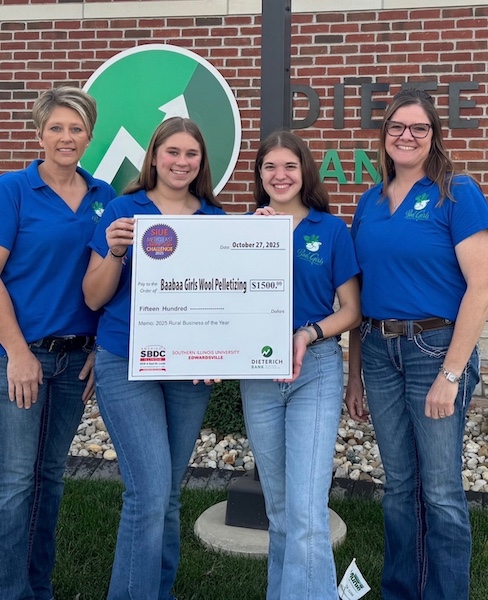
Though they ultimately didn’t take home the first-place prize, they were named Best Rural Business and received $1,500 towards the project.
Further contributing to the startup, both students have also received supervised agricultural experience grants through FFA, each earning $1,000 after applying.
Leanna noted her thanks for Valent, the ag company which sponsored these scholarships.
Further, Dieterich Bank served as sponsor for the $1,500 rural business award, and the bank reached out soon after the contest to voice their support.
On something of a time crunch to get hold of the pelletizing equipment, the Stechmessers and Hallerans got in touch with Dieterich Bank to see about getting a loan to fill the gap in their funds.
They worked with Chris Pickett, vice president of lending at Waterloo’s Dieterich Bank location, who Leanna said was hugely supportive of the project.
The loan closed in December, and Leanna further noted Pickett provided a personal check such that he and his wife might be the first customers of BaaBaa Girls Wool Pelletizing.
For now, the group is lying in wait to get ahold of their equipment, with the business set to be housed at the Stechmesser farm.
“As soon as we get the equipment, we plan on getting things processed and bagged,” Leanna said. “The intention is to be in Waterloo at the farmers market, any of the festivals and street markets and all that kind of thing, whatever’s out and about.”
In fact, the annual Southern Illinois Sheep and Craft Festival takes place April 11 at the fairgrounds.
Gracie and Kaleigh spoke a bit about their own experiences with the project, with Gracie commenting on how they’ve centered their business around sheep, which have long been a focus of their 4-H and FFA work.
“Through our projects, we have the waste wool, and we were trying to come up with a way to use that waste wool and make a by-product that can be put back out into the community so the wool we’ve been producing isn’t such a big waste,” Gracie said.
She further spoke about how their experience with these youth ag groups has helped prepare them for much of the particulars of operating a business.
“Me and Kaleigh have both been making cash flow statements with our 4-H record books since we were 8 when we joined 4-H,” Gracie said.
Kaleigh spoke about the satisfaction of starting a business at such a young age, speaking to the excitement about a business they’ve been trying to put together for years finally coming together.
“It’s definitely felt pretty good, especially being as young as I am and seeing the future before me be now, I can get started and become maybe even a world-wide business when I get older for all I know,” Kaleigh said. “Working with my best friend, it’s really helpful that she’s there. We back each other up.”
She likewise spoke about having her experience with sheep come in handy with the business, further touching on how the entrepreneurial experience will likely help her in her FFA career.
“It’s been a lot more helpful when I’m starting a business with something that I’ve done since I was 3 years old,” Kaleigh said. “It helps me especially because I’m finally getting to do something that’s not just show my animals. I’m getting to show off in another way, and I can incorporate all of the things that I’ve already done with 4-H and FFA.”
Amy also offered her thoughts on the project, describing the work they’ve put into the business.
“Seeing them have the idea and them wanting to grow it and do all of this as much on their own as much as they possibly could has been amazing for me, just to watch them at their age want to do something like this,” Amy said.
She and Leanna also emphasized just how great their daughters can be when they’re working together.
“Gracie and Kaleigh work together very well,” Amy said. “They’re kind of like a yin and a yang when it comes to what both of them are good at, but they support each other to the nth degree.”
Amy and Leanna also both voiced additional thanks to everyone in the community that has shown their support, namely folks from the Monroe County Sheep Producers who have offered to share their wool.
Leanna further commended the girls for their hard work and creativity.
“This is something that they dreamt up,” Leanna said. “They were curious kids one night and did what kids do these days and that’s search the internet and find a use for something, and this is what they came up with.”