
Muddy waters in service dispute
Hopes of ending a legal dispute between the cities of Waterloo and Columbia went down the drain last Tuesday.
Following a hearing of motions Jan. 20 – almost a year to the day since the City of Columbia approved a “municipal services agreement” for new business owners just north of Hanover Road – a judge found that neither city was “entitled to a judgment as a matter of law.”
The order entered into the record Feb. 3 in Monroe County Circuit Court by Judge Jennifer Becker-Roscow denied motions for partial summary judgement filed on behalf of both cities.
The judge found “there is a genuine issue as to the material facts” presented in both cities’ motions, setting the matter to be heard during a jury trial tentatively scheduled for March 30.
A pre-trial hearing in the matter is scheduled for March 11.
A “demand by trial by jury of 12” was entered June 27 by Laura Beasley, attorney for Columbia, which is somewhat unusual for a case of this type.
Generally, “miscellaneous remedy” filings are decided by an arbiter or a judge as part of a bench trial.
Juries are generally assigned to civil matters in Illinois only if there are damages being sought – which they are not in this matter other than possible payment of legal fees.
During a hearing on the case last month, an attorney for Fountain Water District offered the opinion that arbitration may be necessary to assess claims presented by attorneys on behalf of Columbia
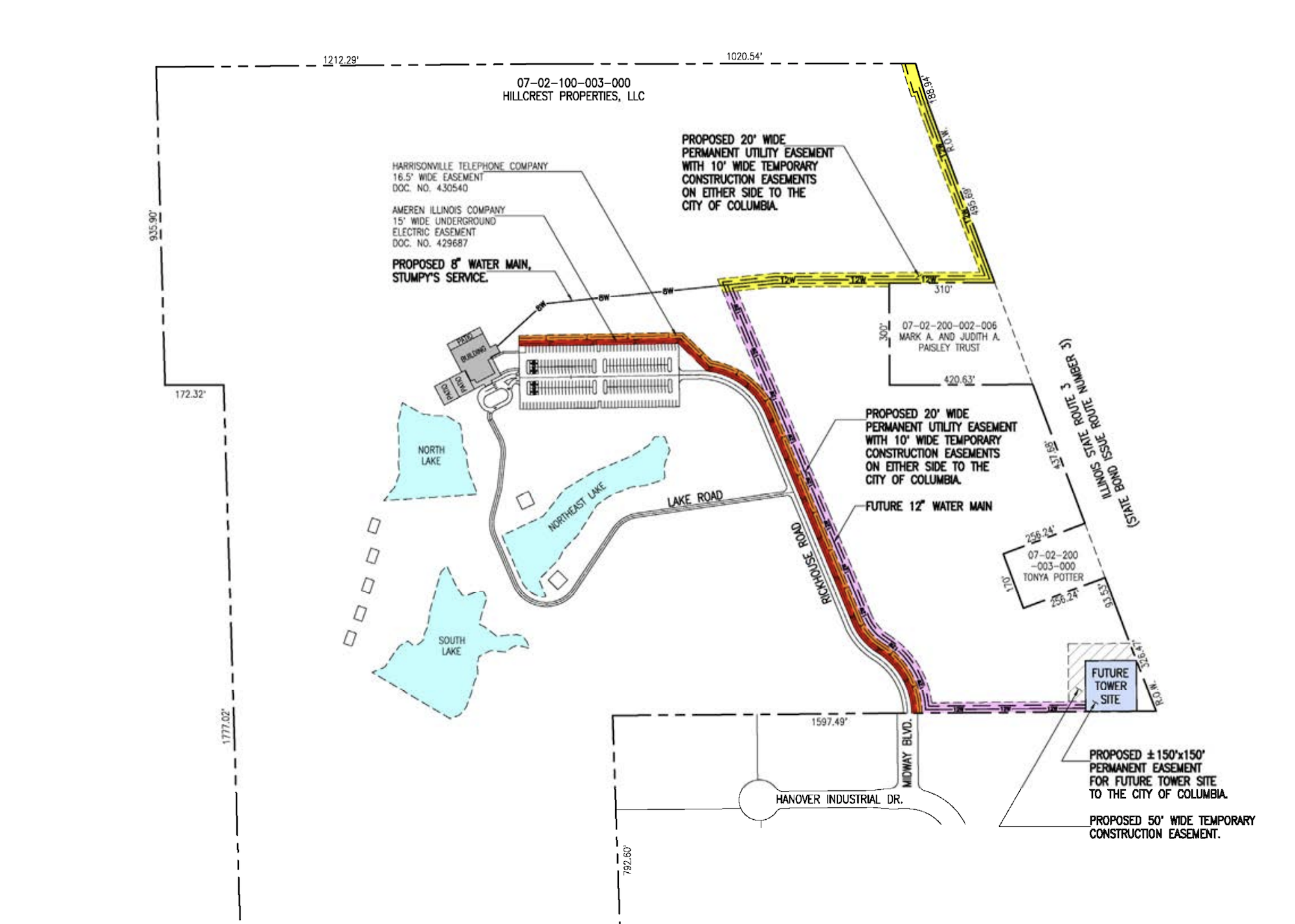
The matter began Jan. 21, 2025, when the Columbia City Council approved an agreement with owners of Old Monroe Distillery Co. to allow Columbia to provide water service to an event center being built at 8787 Rickhouse Road just west of Route 3 and north of Hanover Industrial Drive in unincorporated Monroe County.
While the property in question has a Columbia mailing address, it is slightly over 1.5 miles south of Columbia city limits and just outside a “growth boundary” described in the city’s comprehensive plan approved in late 2024.
A complaint for declaratory judgment was filed by the City of Waterloo in April 2024 which claimed it had the “exclusive right” to provide water service in that area per state statute.
The original complaint also noted the distance from the facility to the closest point of Columbia’s city limits was more than 1.5 miles, thereby barring Columbia from providing such service regardless of Waterloo’s objection.
Columbia filed a response to the complaint in late June, arguing Waterloo “has failed to state a claim upon which relief may be granted” and noting a June 2022 notice to Fountain Water District in which Columbia stated intent to exercise its agreement option “to purchase facilities contracted and installed by Fountain Water in the Columbia service area.”
In the motion for partial summary judgment filed in October, the City of Waterloo asked the judge to find that Columbia lacked standing to purchase the infrastructure as the property in question is clearly situated outside a 1999 service area agreement between Columbia and the Fountain Water District.
In November, Columbia filed a similar motion asking the court to find it is entitled to provide service to the property.
During the hearing last month, Beasley agreed that the Old Monroe Property was not included in this service area agreement, but she argued the agreement entitles Columbia to purchase Fountain Water facilities if they are “integrated” with existing infrastructure.
Arguing on behalf of Waterloo, attorney William Stiehl called Columbia’s interpretation of the agreement a “red herring,” pointing out that no Fountain Water facilities were installed by Fountain Water on that property prior to purchase by Old Monroe.
In fact, several documents included in a March 3, 2025, Columbia City Council agenda packet show plans for infrastructure to be connected to an Illinois American Water main on the east side of Route 3, and there is no mention of existing Fountain Water infrastructure being used for the project.
The site is considered to be a key to Columbia’s eventual southern growth as described by its recent comprehensive plan.
The original ordinance to provide water service also includes a pre-annexation agreement in which the owners of the property agree to become part of the City of Columbia once the Old Monroe property abuts an annexed property in the future.
The city also reimbursed the owners of this property $452,273 for costs incurred for installation of water mains and other infrastructure.
The March 3 agenda schematics also shows the location of a potential water tower on the Old Monroe parcel which would presumably be used to facilitate water service to future southern expansion.
A cease and desist letter dated Jan. 30 was sent on behalf of Waterloo to the involved parties.
The letter refers to Columbia’s stated goal of southern expansion as outlined in its comprehensive plan while also pointing out the city appears to be ignoring another aspect of the plan as written.
“On page 58 (of Columbia’s 2024 Comprehensive Plan), it is stated that ‘Columbia should work with Waterloo to establish an annexation and growth boundary agreement.’ It is unfortunate that this was never done during all the time Columbia has apparently been planning this project,” the letter stated.
In other information obtained through a Freedom of Information Act request, the plans were discussed in an email dated Nov. 1, 2024, between Columbia City Administrator Doug Brimm and the property owner and project manager overseeing construction of the Old Monroe facility.
The letter also notes former Columbia Mayor Lester Schneider and former Mayor Terry Kipping both signed a letter in March 2004 which stated “the City of Columbia takes no exceptions to the Facility Planning Area revision proposed by the City of Waterloo.”
That revision included an area south of FF Road and west of Route 3 – the area in which the Old Monroe facility was constructed – as part of Waterloo’s future intended water and wastewater service areas.