
Water war trickles on
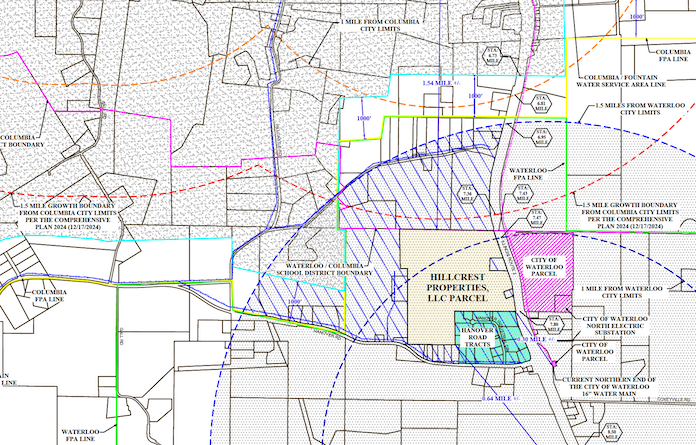
After several delays, attorneys for the cities of Waterloo and Columbia on Tuesday were finally able to argue their motions concerning a water service dispute in Monroe County Circuit Court.
In April, a complaint for remedy was filed by the City of Waterloo following action by the City of Columbia which established a water utility connection to a new business west of Route 3 and just north of Hanover Road in unincorporated Monroe County.
While a number of motions have been filed since the last hearing in early September, attorneys for both cities only addressed their respective client’s request for summary judgement.
In early October, Waterloo filed a motion requesting the court find Columbia “has no authority to purchase Fountain Water District facilities or to provide water service” to the parcels in question.
Columbia filed a similar motion in mid-November asking the court to find that it does have legal standing to provide service.
In the original filing, Waterloo accused Columbia of acting outside its jurisdiction by installing its own water pipes and connecting to a water main to provide service to Old Monroe Distillery Co., 8787 Rickhouse Road.
While Old Monroe has a Columbia mailing address, all water service in the Hanover Tracts and Hillcrest Property parcels has been handled by Fountain Water District, not a municipal provider.
Both cities have “service area agreements” with Fountain Water which provide a mechanism to take control of Fountain Water “facilities,” which include underground water utility lines.
Both cities claim they have the right to provide water service to the relevant properties.
Arguing on behalf of Waterloo on Tuesday, attorney William Stiehl told presiding 24th Judicial Circuit Judge Jennifer Becker-Roscow the case “may be the easiest” she will ever hear, explaining a resolution is a matter of simply determining “where do two properties sit.”
Pointing to a well-defined boundary in a map of a 1999 service area agreement between Columbia and Fountain Water, Stiehl described a “clear, not ambiguous” boundary established in the “Columbia Service Area.”
With the Hanover Tracts and Hillcrest Property clearly resting outside of the area’s boundary, Laura Beasley, attorney for Columbia, began her argument by stating she and her client “don’t disagree” with Stiehl’s assessment of the service area map.
However, she argued the service agreement entitles Columbia to purchase Fountain Water facilities if they are “integrated” with existing infrastructure to a degree that not purchasing the facilities would “be a detriment” to customers.
Waterloo attorney Otto Faulbaum responded by saying Columbia has “never produced the agreement” which would allow a purchase of Fountain Water infrastructure outside of its service area agreement.
Faulbaum also pointed to a 2011 agreement between Waterloo and Fountain Water which he said includes almost the exact same language, apart from geographical descriptions.
He continued by noting that, per state statute, Columbia’s city limits are not within the one-mile radius needed to claim service rights just north of Hanover Road near Route 3, or 1.5 mules with Fountain Water consent.
Stiehl had previously argued Columbia’s service agreement was bound by specific geography while Waterloo’s agreement allows them to assume Fountain Water service on any property within 1.5 miles of Waterloo city limits.
He also called Columbia’s interpretation of the agreement a “red herring,” saying any Fountain Water facilities would need to have been installed by Fountain Water prior to purchase by Columbia or Waterloo.
Attorney Robert Chandler argued Columbia’s agreement with Fountain Water is fundamentally different than the agreement with Waterloo, saying the Columbia agreement “contemplates purchasing (Fountain Water) infrastructure.
Stiehl then described the rationale presented by Columbia’s attorneys as a “poor concept,” calling Columbia’s claim a “magical transformation” of its service area agreement with Fountain Water.
“Where does it end? One mile? Five miles?” Stiehl asked, with Chandler countering by saying Columbia does not intend to try to take over an excessive amount of infrastructure, only that which is deemed appropriate by city officials – in this case, water lines in a region less than half a mile from its service area.
Attorney Art Morris, representing Fountain Water, was asked if he had any input.
While Morris noted his client was only named as an involved party, he did offer his assessment of the situation.
His conclusion was that the water district is “bound by both” its contracts with Waterloo and Columbia, adding that more information pertinent to Columbia’s claims that its work on the Old Monroe property was “necessary” to provide service.
“We may have to arbitrate” due to the technical nature of the claim, Morris said, adding, “I say ‘good luck.’”
While it was not argued in court, it has been noted in previous filings that water service to the Old Monroe property is provided by access to an Illinois American main on the east side of Route 3 with no Fountain Water lines or facilities being used for water service to that property specifically.
If Becker-Roscow does not grant a partial summary judgment to either party, a pretrial hearing in the matter is scheduled for March 11, with a jury trial tentatively set for March 30.